Guide · Updated
Paddle stacking in pickleball: how it works, and a fairer way
Paddle stacking is the usual way pickleball open plays decide who plays next: paddles wait in a line, and the next four go on when a court opens. This guide covers how it works, the common rules, where it breaks down, and a fairer way to run the line.
What is paddle stacking?
At open play, more people show up than the courts can hold. Paddle stacking is the queue: instead of standing in line, players leave their paddles in line. The paddles sit in a rack, along the fence, or on the ground beside the court, in the order people arrived.
When a game ends and a court is free, the next four paddles are picked up and those four players go on. Nobody needs a sign-up sheet or a host with a clipboard, which is why you’ll see it at almost every public court.
How paddle stacking works, step by step
- Arrive and stack. Put your paddle at the end of the line. If you came with a partner, place your paddles together.
- Wait for a court. Watch the line move up as games finish.
- Go on in fours. When a court opens, the first four paddles in line take it.
- Play one game. Most open plays play to 11, win by 2. Busy venues shorten it or set a time limit.
- Come off and restack. After the game, put your paddle back at the end of the line.
Common paddle stacking rules
There is no official rule. Each venue picks one of these, so ask before you play:
- Four on, four off. All four players leave the court after every game and the next four go on. It is the simplest rule and gives everyone the same number of games.
- Winners stay and split. The winning pair stays for one more game but plays against each other, each with a new partner from the line. Usually limited to two games in a row.
- Winners and losers stacks. Two lines: winners restack in one, losers in the other, and each court is filled from a single line. Stronger players end up meeting stronger players.
- Stacks by skill level. One line per level, each with its own courts, so beginners and advanced players don’t land in the same game.
Where paddle stacking goes wrong
The stack works well for a dozen friends on two courts. It strains once the group grows:
- The order gets lost. Paddles get moved, knocked over or quietly shifted up, and nobody can prove who was next.
- The same four keep meeting. Players who come off together restack together, so they play each other again and again.
- Games are lopsided. Whoever is next plays, whatever their level. Beginners get run over and strong players get bored.
- Nobody knows the wait. A line of twenty paddles could mean ten minutes or forty.
- Some players get fewer games. Late arrivals, people on a break and shy newcomers fall behind without anyone noticing.
- The host becomes the referee. Every argument about the line ends up with the person who organized the night.
A fairer way: a queue on everyone’s phone
A queue app keeps the same idea, first come, first on, and removes the parts people argue about. This is how Sideout handles each problem:
- The order can’t be moved. Players check in by scanning a QR code and join the queue in arrival order. Everyone sees the same line on their own phone.
- Fewer repeats. In Balanced mode, nobody shares a court with anyone from their last game, so partners and opponents keep changing.
- Even teams. Give players a level from Beginner to Advanced, and each group of four is split into two evenly matched teams.
- A wait you can see. Players see their place in line and roughly when they’ll play.
- Equal games. The host can let players with the fewest games go first, so nobody is left behind.
- The host stays in charge. The host can still pick the four for any court by hand.
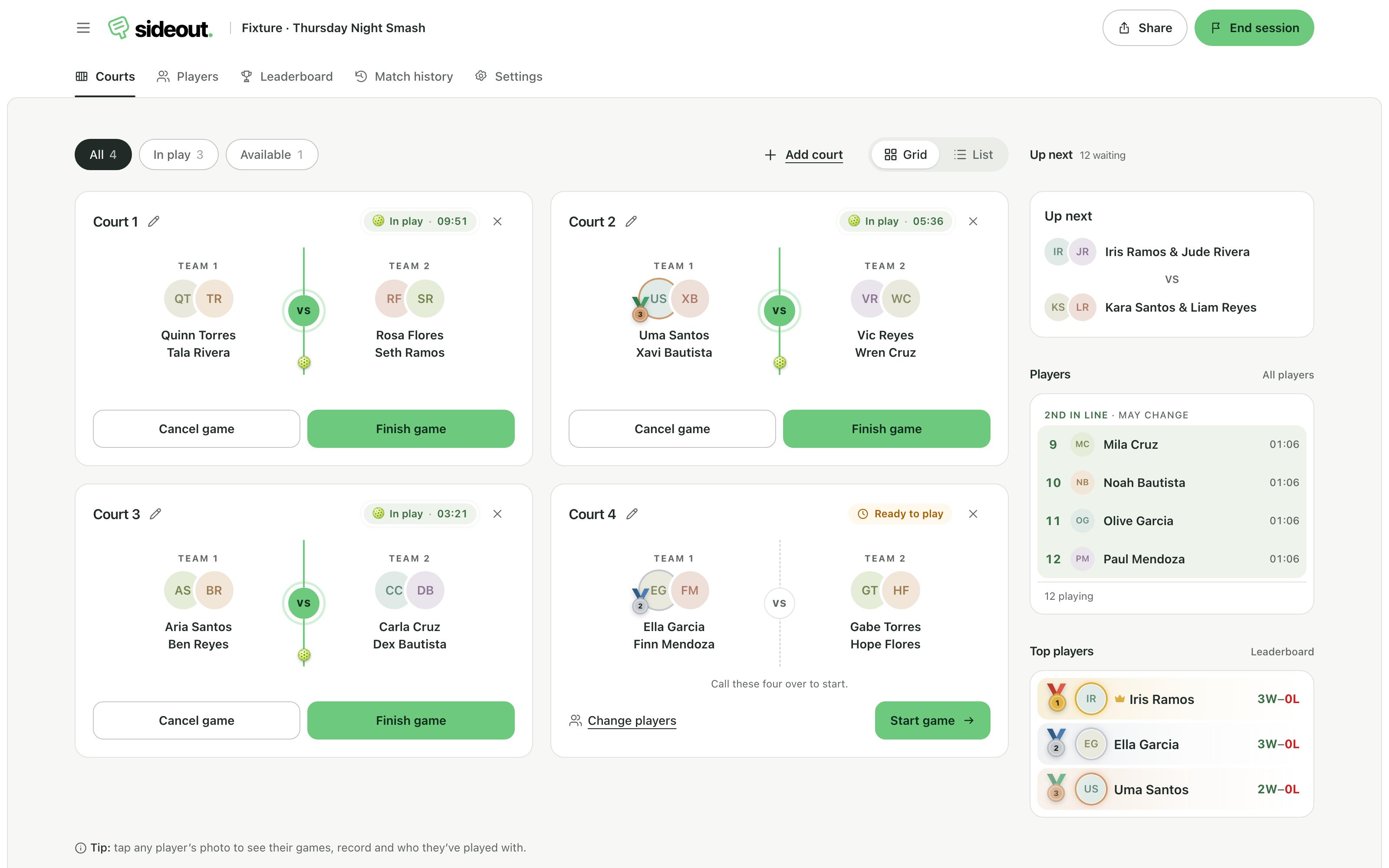
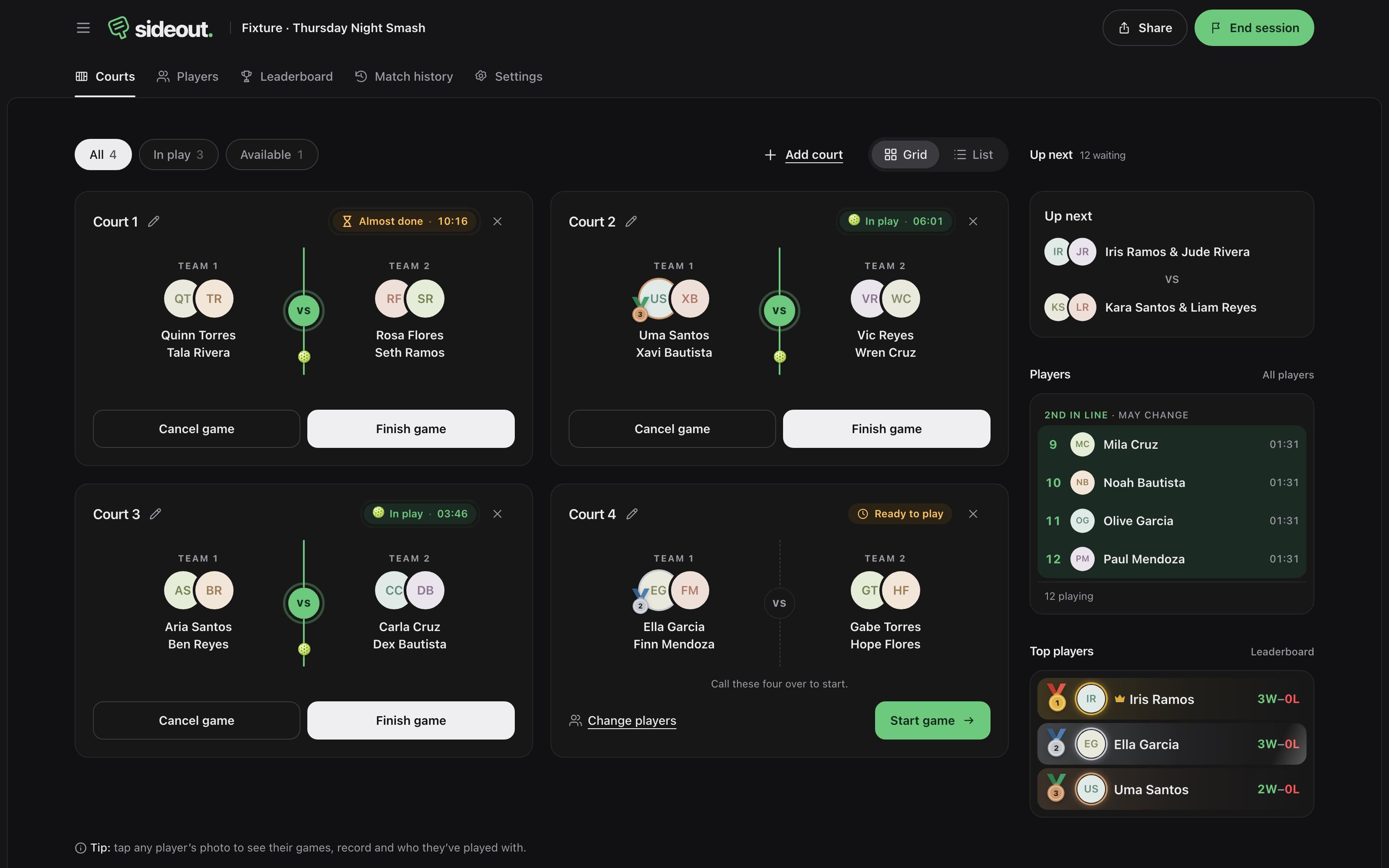
It’s free, it runs in the browser, and players don’t need to download anything or make an account.
Paddle stack or queue app: which should you use?
Keep the paddle stack if you have one or two courts, a small group that knows each other, and nobody minds who they play.
Switch to a queue app if you have three or more courts, more than about 16 players, mixed skill levels, or players who pay to join and expect a fair number of games. That is the point where the line stops looking after itself.
Comparing apps? See Sideout vs PickleQ.
Common questions
What does paddle stacking mean in pickleball?
It's how players line up for a court at open play. Each player puts a paddle in a row or a rack, and when a court opens, the next four paddles in line go on to play.
How many paddles go on at a time?
Four for doubles, which is how almost every open play runs. With the common four on, four off rule, all four players come off after the game and the next four paddles go on.
Do winners stay on the court?
Only if the venue says so. Some groups let winners stay for one more game and split up as partners; many busy open plays send all four off so the line keeps moving. Ask the host before your first game.
Can I stack my paddle with a friend's?
Usually yes: put your paddles next to each other and you'll go on together. Most venues don't allow holding a place for someone who hasn't arrived yet.
Is there an app that replaces paddle stacking?
Yes. Sideout is a free web app where players check in with a QR code and join a queue on their phone. When a court opens, it sends the next four on and can split them into evenly matched teams.